
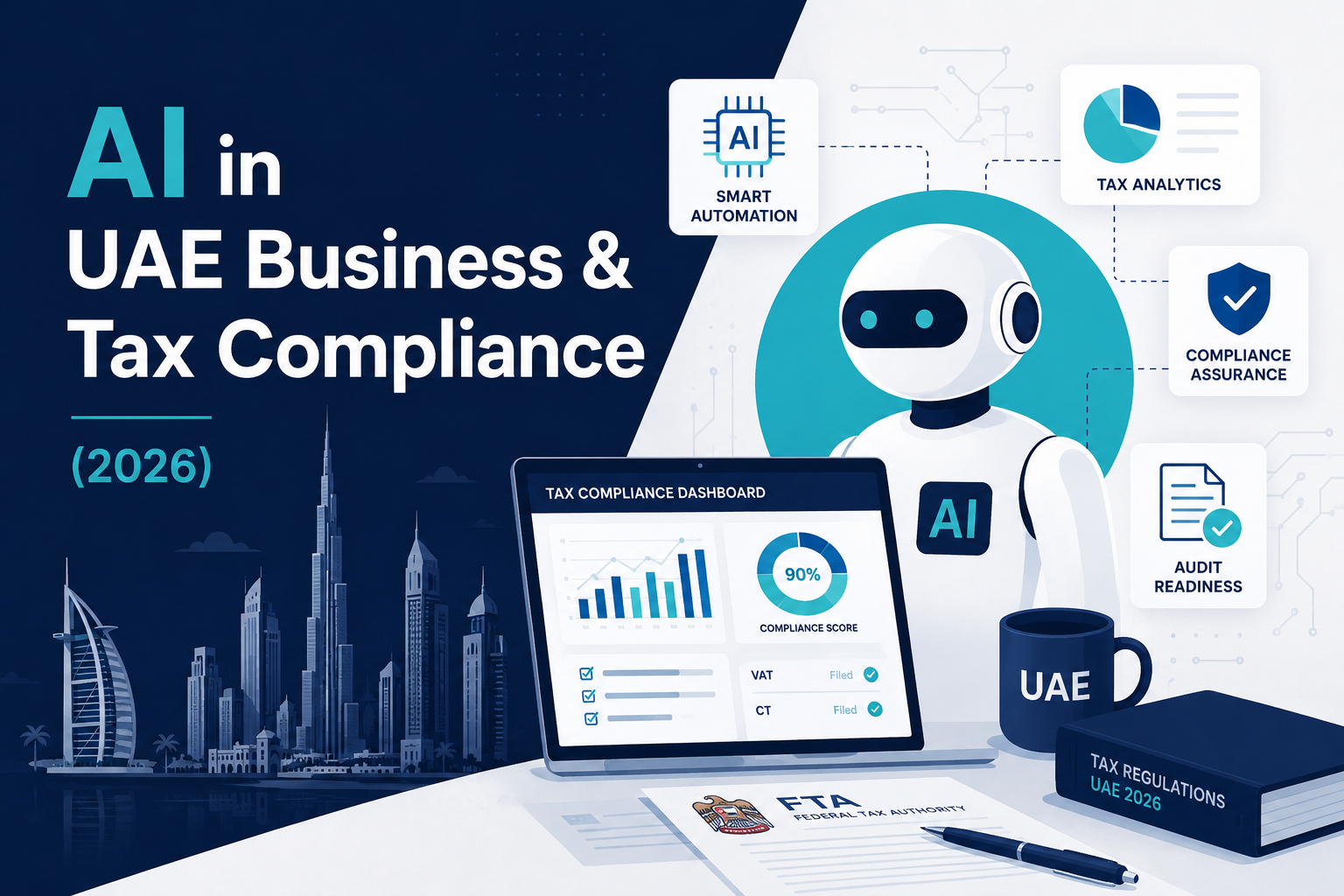
The UAE’s tax landscape has changed dramatically in the last three years. With corporate tax now in full effect, VAT compliance firmly embedded, and the Federal Tax Authority pushing ahead with digital-first enforcement, businesses operating here face a level of regulatory complexity that simply did not exist a decade ago. And they are increasingly turning to artificial intelligence to keep up.
AI is no longer a futuristic promise. It is actively reshaping how UAE businesses handle bookkeeping, invoice management, transfer pricing documentation, and FTA submissions. But there is a catch: AI tools are only as reliable as the people overseeing them.
This post breaks down exactly how AI is being used in UAE business processes and tax compliance today, what it does well, where it falls short, and how to use it smartly.
The Compliance Burden Facing UAE Businesses in 2026
Before diving into AI, it is worth understanding what UAE businesses are actually managing:
- Corporate Tax (CT): Federal Decree-Law No. 47 of 2022 introduced a 9% CT rate on taxable profits above AED 375,000. Businesses must maintain compliant financial records, calculate taxable income accurately, and file returns through the EmaraTax portal.
- Value Added Tax (VAT): A 5% VAT applies to most goods and services. Businesses must track input and output tax, issue compliant invoices, and file returns quarterly or monthly.
- Transfer Pricing: Companies with related-party transactions must maintain arm’s-length documentation, a requirement that is both data-heavy and legally consequential.
- Economic Substance Regulations (ESR): Certain business activities require annual notifications and reports demonstrating genuine economic activity in the UAE.
Managing all of this manually, especially across multiple entities or Free Zones, is time-consuming, error-prone, and expensive. That is where AI enters the picture.
5 Ways UAE Businesses Are Using AI Right Now
1. Automated Bookkeeping and Transaction Categorisation
AI-powered accounting platforms such as Xero, QuickBooks Online, and Zoho Books now use machine learning to:
- Automatically categorise bank transactions based on historical patterns
- Match invoices to purchase orders
- Flag anomalies or duplicate entries in real time
- Generate trial balances and reconciliations with minimal manual input
For UAE businesses managing high transaction volumes, particularly in retail, hospitality, or logistics, this cuts bookkeeping hours significantly and reduces the risk of misclassification that could trigger VAT discrepancies.
2. VAT Invoice Processing and Compliance Checks
The FTA has specific requirements for tax invoices in the UAE, including mandatory fields, correct VAT registration numbers, proper tax calculations, and Arabic language requirements in some contexts. Mistakes on invoices can result in penalties or rejected input tax claims.
AI document processing tools can now:
- Extract data from scanned or digital invoices using Optical Character Recognition (OCR)
- Verify that all mandatory fields are present
- Flag invoices that do not meet FTA standards before they are posted
- Reconcile supplier invoices against purchase orders automatically
This is particularly valuable for businesses receiving large volumes of invoices from multiple suppliers across the UAE and internationally.
3. Corporate Tax Computation Support
With UAE corporate tax still relatively new, many businesses are working through the nuances: what qualifies as exempt income, how to apply Small Business Relief (SBR), how to treat intra-group transactions, and whether their Free Zone activities qualify for the 0% Qualifying Free Zone Person (QFZP) rate.
AI tools embedded in accounting software can:
- Calculate preliminary taxable income based on financial data
- Identify items that may need adjustment such as entertainment expenses and depreciation differences between accounting and tax treatment
- Model different scenarios, for example the tax impact of restructuring revenue streams
4. EmaraTax Filing Preparation
The FTA’s EmaraTax portal is the single point of truth for UAE tax submissions. AI is being used to:
- Pre-populate return data by pulling directly from accounting software
- Perform pre-submission validation checks to catch errors before filing
- Generate the supporting schedules and reconciliations the FTA may request
- Track filing deadlines and send automated alerts
Some integrated platforms now offer near-seamless data flow from general ledger to EmaraTax-ready output, reducing the manual re-entry that was previously a significant source of error.
5. Financial Forecasting and Cash Flow Management
Beyond compliance, AI is helping UAE business owners make better financial decisions:
- Cash flow forecasting: AI analyses historical patterns to predict future cash requirements, useful for planning VAT payment obligations.
- Profitability analysis by entity or department: Helps businesses understand where margin is being generated or eroded.
- Scenario modelling: What happens to your tax position if turnover crosses the AED 375,000 threshold? What if you add a new Free Zone entity?
This kind of forward-looking analysis was previously the domain of expensive financial consultants. AI has democratised access to it, though interpretation still requires expertise.
Where AI Falls Short in UAE Tax Compliance
AI tools are powerful, but they operate within defined parameters. Here is where human oversight remains non-negotiable:
| Area | Why AI Is Not Enough |
|---|---|
| QFZP Eligibility | Requires legal interpretation of qualifying income and activity tests |
| Transfer Pricing Documentation | Involves comparability analysis and professional benchmarking judgement |
| FTA Voluntary Disclosures | Requires strategic assessment of exposure and penalty mitigation |
| Cross-Border Tax Positions | Double tax treaty interpretation requires case-by-case legal analysis |
| Audit Representation | Human communication, documentation strategy, and negotiation required |
| Related-Party Transactions | Substance, form, and intent must all be assessed by a qualified professional |
A Practical AI Adoption Framework for UAE Businesses
If you are looking to integrate AI into your finance and compliance operations, here is a sensible starting point:
- Audit Your Current Processes Map out your existing bookkeeping, invoicing, and filing workflows. Identify where time is being lost and where errors most frequently occur.
- Clean Your Financial Data AI learns from your data. Before deploying any tool, ensure your chart of accounts, vendor records, and transaction history are accurate and consistently structured.
- Start With a Contained Use Case Do not attempt to automate everything at once. Start with one function, such as invoice processing or bank reconciliation, and validate accuracy before expanding.
- Integrate With EmaraTax-Compatible Software Choose platforms that either integrate directly with EmaraTax or export in FTA-compatible formats. Ask your software provider explicitly about UAE regulatory compliance.
- Maintain Professional Oversight Assign a qualified accountant or engage a firm like Protax Advisors to review AI-generated outputs before submission. This is not optional. It is the control that makes AI adoption safe.
The Human-AI Partnership: What Protax Advisors Recommends
At Protax Advisors, we work with businesses across Dubai, Abu Dhabi, and the broader UAE that are at various stages of AI adoption. Our view is straightforward:
The most effective model we see is one where AI handles data processing, routine categorisation, and preliminary calculations, while qualified tax professionals handle interpretation, strategy, and submissions. This combination delivers the efficiency benefits of technology without the risk of unreviewed errors reaching the FTA.
Whether you are a Free Zone company assessing your QFZP status, a mainland business filing your first corporate tax return, or an SME exploring whether Small Business Relief applies to your situation, the answer is not in a chatbot. It is in a conversation with a professional who understands your specific circumstances.
Final Thoughts
AI is not replacing tax compliance professionals in the UAE. It is, when used correctly, making their work more accurate, their clients better informed, and their practice more efficient.
But the regulatory stakes are real. The FTA operates on data, documentation, and deadlines. Errors that might have slipped through in an earlier era of manual filing are increasingly visible in a digitised enforcement environment.
Ready to Bring Structure and Expertise to Your UAE Tax Compliance?
Protax Advisors LLC works with businesses across the UAE to ensure accurate, timely, and fully compliant tax filings, with the professional oversight that AI alone cannot provide. Speak with a UAE tax specialist today.