
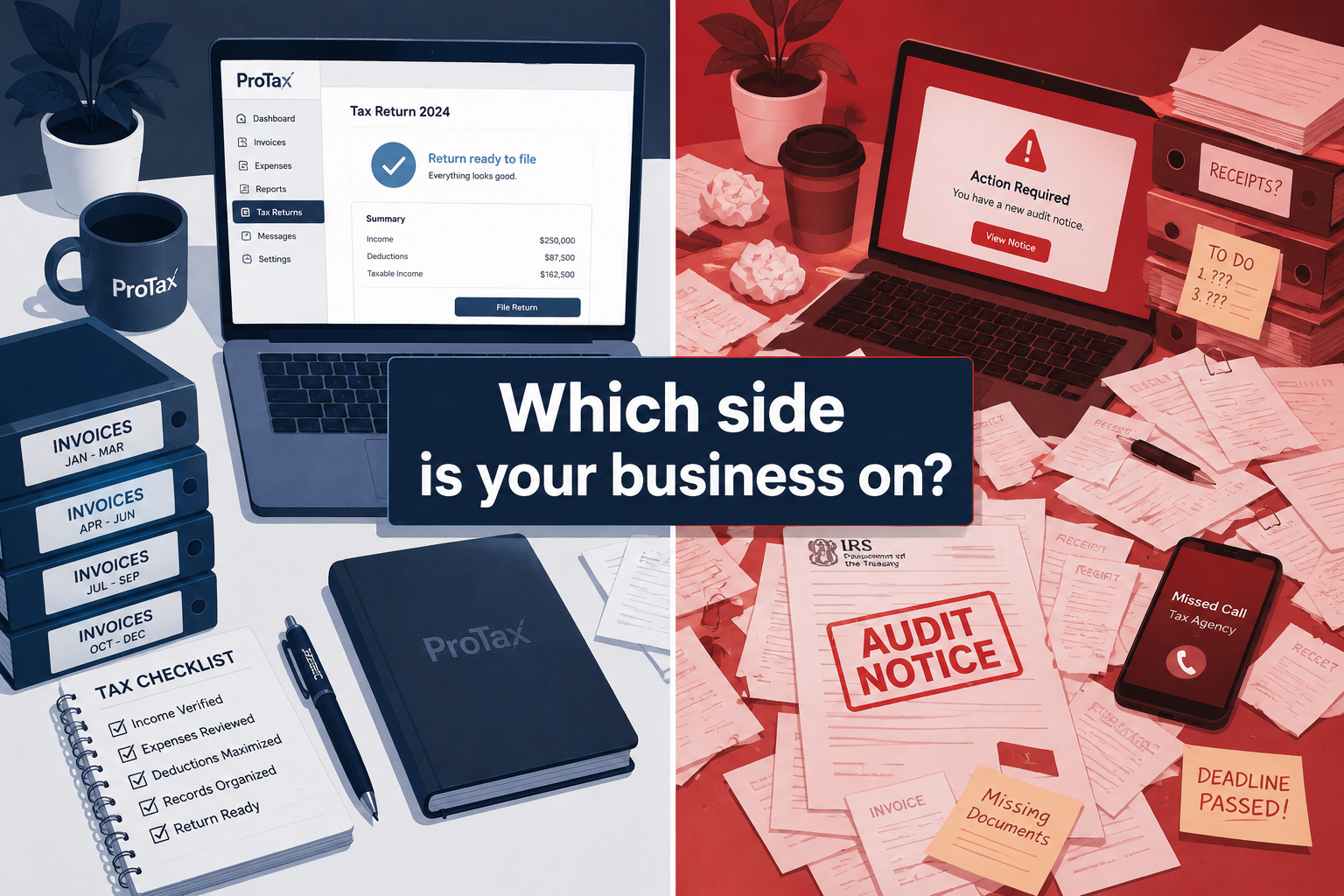
In 2024 alone, the UAE’s Federal Tax Authority (FTA) conducted 93,000 inspection visits — a staggering 135% increase from the previous year. If you still think an FTA audit is rare, that assumption is now outdated — and potentially expensive.
More importantly, these audits are not random. The FTA operates on a risk-based, data-driven selection system, built on an ISO 31000-certified risk management framework. It continuously analyses VAT returns, corporate tax filings, customs data, and financial patterns. When your numbers deviate from what the system expects, your business is flagged — often before you even realise something is wrong.
Here’s the part most businesses miss: the triggers behind these audits are not hidden. They are repeatable patterns, seen across thousands of cases every year.
The majority of audit selections — and penalties — come down to a small set of common VAT compliance mistakes. Businesses that understand these patterns can identify risks early, fix them proactively, and significantly reduce their chances of being audited.
Here are the seven VAT mistakes the FTA sees most often — and exactly what to do about each one.
Mismatch Between VAT Returns and Corporate Tax Filings
One of the fastest ways to get flagged is inconsistency between your VAT returns and corporate tax filings. The FTA now cross-references both automatically. If your VAT returns show AED 120 million in taxable supplies but your corporate tax return reports AED 100 million in revenue, that AED 20 million gap is immediately identified as a risk signal.
A common real-world scenario: a business excludes certain income from its corporate tax return, assuming it is non-taxable, but includes it in VAT filings. From the FTA’s perspective, this looks like underreported revenue. The consequence is almost always an audit trigger, followed by requests for reconciliation and supporting documentation.
Misclassifying Zero-Rated and Exempt Supplies
This is one of the most frequent findings in FTA audits. Many businesses treat zero-rated and exempt supplies as interchangeable because both result in 0% VAT on invoices — but they are not the same.
Zero-rated supplies allow you to recover input VAT on related costs. Exempt supplies do not.
A typical mistake occurs in sectors like healthcare, education, or real estate. For example, a business incorrectly treats an exempt residential lease as zero-rated and claims input VAT on maintenance or service costs. This results in overclaimed input tax. The FTA treats this as a direct financial impact error, often leading to reassessments and penalties.
Not Applying the Reverse Charge Mechanism Correctly
The reverse charge mechanism (RCM) is one of the most commonly misunderstood areas of UAE VAT. When you import services or certain goods from overseas suppliers, you are required to account for VAT yourself — even if the supplier does not charge UAE VAT. This applies frequently to software subscriptions, digital advertising platforms, and foreign consultants.
Many small and mid-sized businesses miss this entirely. For example, a company paying a foreign SaaS provider may record the expense but fail to declare VAT under RCM in its return.
Failure to apply RCM correctly is widely considered one of the most common audit findings in UAE businesses.
Incorrect VAT Registration Timing
VAT registration errors are more common than expected, particularly among growing businesses. The registration threshold is AED 375,000 in taxable supplies — but critically, this is calculated on a rolling 12-month basis, not a calendar year and not based on your trade license date.
A typical mistake: a business crosses the threshold in May but delays registration until year-end, assuming it can wait for the calendar cycle to close. The FTA considers this late registration.
The consequences include:
- A fixed AED 10,000 penalty
- Retroactive VAT liability from the date the threshold was crossed
Inadequate Record-Keeping and Documentation
Even perfectly calculated VAT returns can fail under audit if they are not supported by documentation. During an audit, the burden of proof lies entirely on the taxpayer.
The FTA requires businesses to maintain comprehensive records, including:
- Tax invoices and supplier invoices
- Contracts (written, not verbal)
- Bank statements
- Stock and inventory records
- Proof of delivery
Businesses often assume that correct numbers are enough. They are not. Failure to produce records can result in penalties starting at AED 10,000 — even if the VAT calculations themselves are accurate.
Large or Frequent VAT Refund Claims Without Strong Documentation
VAT refunds are legitimate — but they attract attention. When a business regularly submits large refund claims, the FTA applies higher scrutiny. This is because refunds involve releasing government funds, and the authority requires a high level of confidence in the claim’s accuracy.
This is especially common in:
- Export-driven businesses
- Capital-intensive industries
- Companies with large upfront input VAT (e.g., property or equipment investments)
A typical issue arises when supporting documents — such as invoices, import records, or proof of export — are incomplete or not readily available. The consequence is delayed refunds, detailed reviews, or full audits.
Supplier Due Diligence Failures
This is one of the most important changes under the amended VAT Law effective January 1, 2026. Previously, businesses relied on having a valid supplier TRN to justify input VAT recovery. That is no longer sufficient.
If your supplier is involved in tax evasion — for example, collecting VAT but not remitting it — and your business knew or should have known, the FTA can deny your input VAT claim.
A common scenario: a supplier charges VAT on services that should be exempt or outside scope. If this goes unchecked, it becomes your compliance risk as well. The consequence is denied input tax recovery and potential penalties.
The fix is to implement basic supplier due diligence:
- Verify TRNs through the FTA portal
- Review whether VAT treatment makes sense
- Flag inconsistencies in supplier invoicing
What to Do If You Recognise Any of These in Your Own Business
If you recognised any of these mistakes in your own business, the most important thing to understand is this: finding the issue yourself puts you in a far stronger position than waiting for the FTA to find it during an audit.
Under the penalty framework effective from April 14, 2026, the difference is significant.
| Scenario | Penalty Rate | Example: AED 100,000 Underpaid (6 months) |
|---|---|---|
| Voluntary disclosure by taxpayer | 1% per month from original due date | AED 6,000 |
| FTA identifies during audit | 15% immediately + 1% per month | AED 21,000 |
The next step is to assess the scale of the issue. Errors that do not impact the tax payable can now be corrected in a subsequent return without submitting a formal voluntary disclosure. However, material errors above AED 10,000 must be disclosed through EmaraTax within 20 business days of discovery.
Bottom Line
The FTA’s audit system is not designed to penalise businesses that are actively trying to comply. It is built to detect patterns of non-compliance — especially those that go unaddressed over time.
Businesses that identify issues early, correct them, and strengthen their processes are significantly less likely to attract scrutiny than those that ignore inconsistencies and hope they go unnoticed.
If any of the seven mistakes outlined above sound familiar, the right next step is to assess your exposure and take corrective action before it becomes a formal audit issue.