

A Dubai investor owned three apartments generating AED 480,000 in annual rental income.
For years, he had structured his property holdings through his free zone company. It made sense at the time. The free zone offered administrative convenience, a clean corporate structure, and what he understood to be a favorable tax environment. His operating business ran through the same entity. Everything was tidy.
Then his accountant called.
Two of the three apartments were located on the Dubai mainland. His free zone company, it turned out, was generating mainland rental income that did not qualify for the 0% free zone tax rate. That income was fully taxable at 9% under UAE Corporate Tax. The structure that had worked perfectly for his operating business was creating a tax liability on his property portfolio that he had never anticipated, never provisioned for, and never discussed with anyone because he assumed UAE real estate was simply tax-free.

It still is, for individuals holding property in their personal capacity. But the moment a corporate entity enters the ownership structure, the tax picture changes entirely. And in 2026, with Corporate Tax firmly established and the FTA’s enforcement capacity expanding rapidly, getting that picture wrong is an expensive mistake.
While many property owners remain unaffected by UAE Corporate Tax, certain activities, especially income-generating real estate, can fall under the 9% corporate tax regime depending on ownership structure, activity type, and whether the property is owned by an individual or a legal entity.
The UAE real estate market remains one of the most tax-efficient property investment destinations in the world. Zero annual property tax. No capital gains tax. No inheritance tax. For individual investors, rental income remains completely tax-free. These advantages are real and they are significant.
But Corporate Tax has added a layer of complexity around ownership structure, license status, and entity type that every property owner and investor in the UAE needs to understand clearly in 2026. The investors who get this right protect their returns and stay ahead of FTA scrutiny. The ones who do not are carrying a tax liability they do not know about yet.
This guide covers exactly who pays Corporate Tax on UAE real estate and who does not, what income is taxable, what expenses reduce your liability, how different ownership structures are treated, and what you need to do right now to make sure your property portfolio is structured correctly.
The UAE Real Estate Tax Landscape in 2026
Before getting into the Corporate Tax specifics, it helps to be clear on the baseline. Because the most dangerous assumption a UAE property investor can carry into 2026 is a partially correct one.
The partially correct assumption is this: UAE real estate is tax-free. That statement is true for individuals. It is not universally true for everyone.
Dubai levies zero annual property tax, no capital gains tax, and no tax on rental income, making it one of the most tax-efficient real estate markets in the world. For individual investors, whether resident or non-resident, rental income earned from Dubai property is completely tax-free.
That remains the case in 2026 and there is no indication it will change. If you are an individual holding property in your personal name without a trade license connected to that property, your rental income and any capital gain on sale are outside the scope of Corporate Tax entirely. The UAE’s advantage as a property investment destination for individual investors is intact.
What changed when Corporate Tax was introduced in June 2023 and became fully enforced through 2024 and 2025 is the treatment of property held through corporate entities. Real estate investments made through corporations are subject to UAE Corporate Tax at 9% on income above AED 375,000, unless the company qualifies as a Free Zone Person and the income meets the qualifying income criteria.
This distinction between individual and corporate ownership is the single most important concept in UAE real estate tax planning in 2026. And it is the one that catches the most investors off guard because it requires understanding not just what you own, but how you own it and through what structure.
Beyond Corporate Tax, every property investor in the UAE still faces a set of fixed costs that apply regardless of ownership structure and regardless of tax status.
The Dubai Land Department transfer fee of 4% applies to every property transaction and is typically paid by the buyer at the point of registration. This is the most significant transaction cost in the UAE property market and applies whether you are buying in a personal capacity or through a corporate entity.
Municipality housing fees apply to tenants in Dubai at 5% of annual rent for residential properties, paid through utility bills. Landlords are not directly liable for this but it affects the rental market dynamics that determine achievable yields.
Service charges are levied by developers or Owners’ Associations for the maintenance of common areas, facilities, and building infrastructure. These vary significantly by development and property type but are an unavoidable ongoing cost of property ownership that directly affects net rental yield.
Ejari registration fees apply to every tenancy contract registered in Dubai. The fee is modest but the registration is mandatory and failure to register tenancy contracts creates compliance complications under both the real estate regulatory framework and the VAT system.
For corporate entities holding property, these costs are all potentially deductible against taxable income under the Corporate Tax framework, which is one of the practical tools available to reduce the effective tax liability on rental income. We cover this in detail in Section 5.
The point of establishing this baseline is simple: the UAE property market is still genuinely tax-efficient by global standards. For investors evaluating where to allocate capital, Dubai’s property tax advantages become most visible when placed side by side with other major real estate markets. In the UK, property investors face income tax on rental earnings at rates up to 45%, capital gains tax of up to 24% on sale profits, and stamp duty that can add a further 12% on high-value purchases.
Corporate Tax at 9% on profits above AED 375,000, applied only to income earned through corporate entities, is not a fundamental threat to the UAE’s property investment proposition. But it is a real obligation that requires real planning, real compliance, and real professional oversight to manage correctly.
The investors who understand this clearly are the ones who structure their holdings correctly, claim their deductible expenses accurately, meet their filing obligations on time, and keep their returns protected. The ones who assume the old zero-tax narrative still applies universally are the ones whose accountants are making calls like the one in the opening scenario.
Who Pays Corporate Tax on Real Estate in the UAE and Who Does Not
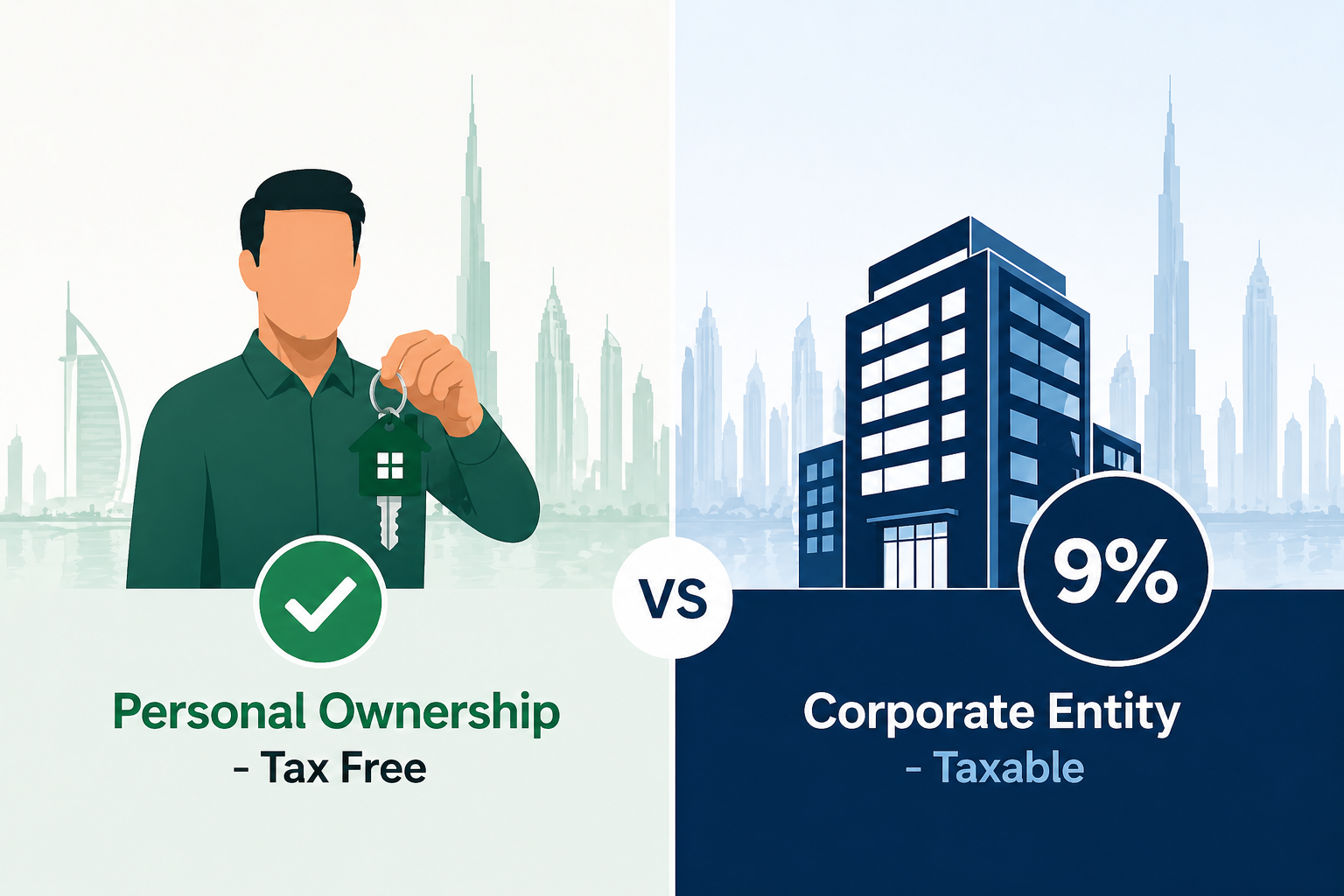
This is the question every UAE property owner and investor needs to answer clearly before anything else. The answer depends entirely on how you hold your property, whether you have a trade license connected to it, and what type of entity sits in the ownership structure.
Individuals Holding Property in Personal Capacity: Generally Exempt
This is the largest category of UAE property investors and the one with the clearest answer.
For most individuals, property remains a steady investment. Rental earnings and capital gains on homes or land generally fall outside Corporate Tax, provided the activity does not require a commercial license and stays below the AED 1 million annual turnover threshold for business activity.
If you own one apartment, three apartments, or ten apartments in your personal name without a trade license, and you collect rent directly from tenants without operating through a licensed business structure, your rental income is outside the scope of Corporate Tax entirely. You pay no Corporate Tax on that income regardless of how much it generates.
This exemption applies to UAE residents and non-residents alike. A foreign investor who owns a Dubai apartment and collects rental income without any UAE corporate structure in place is not subject to Corporate Tax on that income.
The critical word in this category is personal capacity. The moment a corporate entity or a licensed business structure enters the ownership or management picture, the analysis changes.
Individuals With a Trade License Connected to the Property: Taxable
This is the category that catches the most individual investors off guard because the connection between the license and the property is not always obvious.
If a natural person operates a real estate management sole establishment with a license for property management and leasing, and that establishment collects rent and manages tenants, the rental income is considered business income and must be included in the Corporate Tax calculation.
The key test the FTA applies is whether the property activity is being conducted through a licensed business. If the answer is yes, the rental income generated by that activity is taxable regardless of whether the property is held in the individual’s personal name or through the licensed entity.
Consider a practical example. An investor owns four apartments and sets up a sole establishment with a real estate management license to manage them professionally. The sole establishment sources tenants, registers Ejari contracts, collects rent, and handles maintenance. Even though the investor is a natural person and even though the apartments may be registered in their personal name, the FTA treats the rental income as business income because it is being generated through a licensed activity. The Corporate Tax exemption for individual real estate investment income does not apply.
This distinction requires investors who are moving from casual landlord status to more structured property management to review their setup carefully before formalizing the arrangement.
Companies Holding Property: Fully Taxable
Rental income from Dubai property held by a company is fully taxable under UAE Corporate Tax. Companies earning rental income can deduct expenses incurred wholly and exclusively for the purpose of generating that income, but the gross rental income is included in the taxable income calculation from the first dirham.
This applies to all mainland UAE companies including LLCs, civil companies, branches of foreign companies, and any other juridical person registered in the UAE. The 9% Corporate Tax rate applies to taxable income above AED 375,000. Income below that threshold is taxed at 0%, which effectively means the first AED 375,000 of net taxable income is tax-free.
A real estate firm earning AED 600,000 in annual profits pays 9% on AED 225,000, which is the amount above the AED 375,000 threshold, resulting in a Corporate Tax liability of AED 20,250.
For investors with significant property portfolios generating substantial rental income through corporate structures, the liability is proportionally larger. The deductible expense framework covered in Section 5 is the primary tool for managing the effective tax rate.
Free Zone Companies: It Depends on Where the Property Is
This is the most nuanced category and the one responsible for the scenario in the introduction. The answer is not simply yes or no. It depends on where the property is located and what type of property it is.
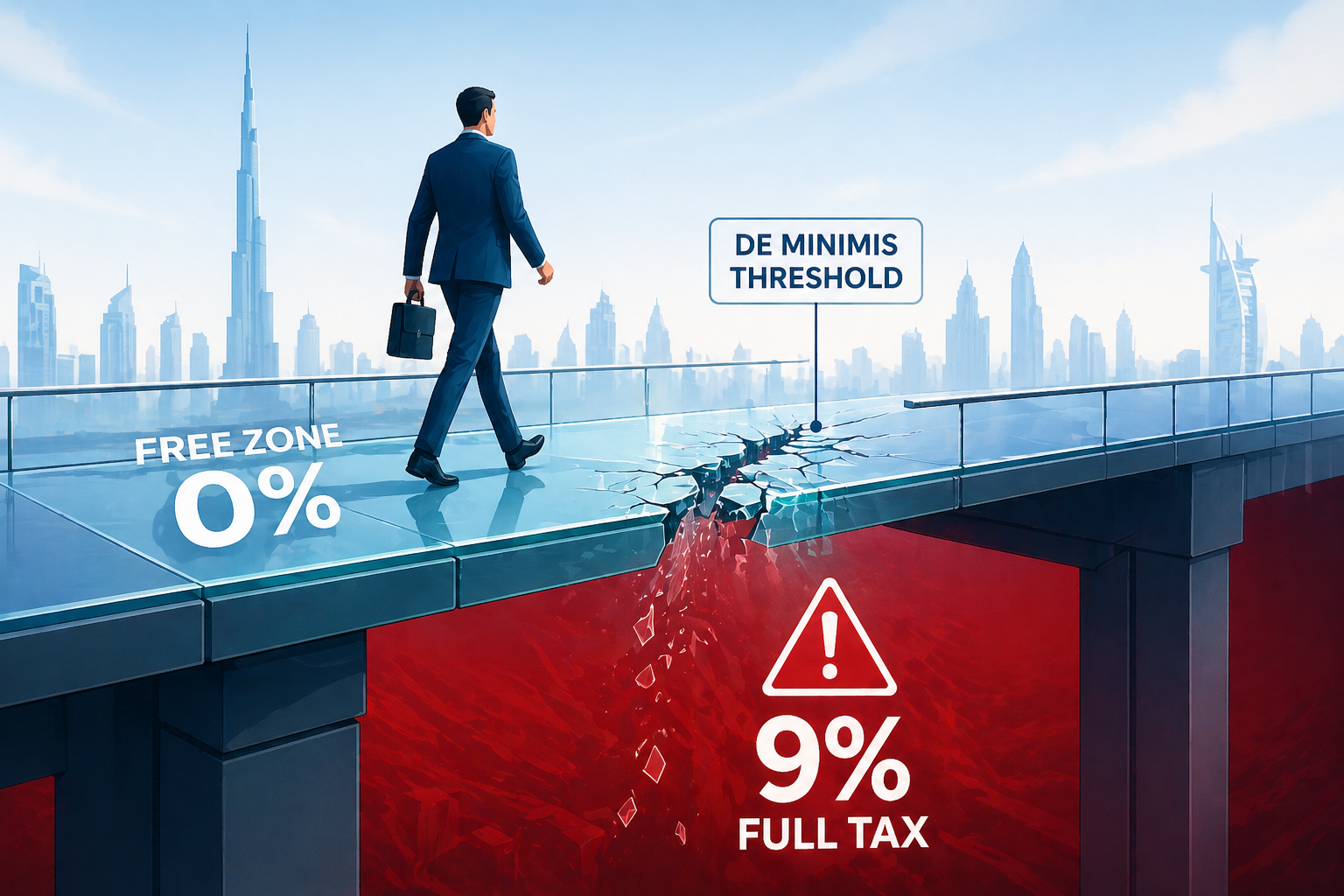
A free zone company earning rental income from a mainland Dubai apartment or office is taxed at 9% on that income regardless of its Qualifying Free Zone Person status. The rental income is non-qualifying income. It does not benefit from the 0% free zone tax rate.
The single exception to this is narrow and specific. A Qualifying Free Zone Person earning income from commercial property located within the free zone, leased to another free zone person, earns qualifying income taxed at 0%.
In plain terms: if your free zone company owns commercial property inside the free zone and leases it to another free zone business, that rental income may qualify for the 0% rate. If your free zone company owns any other property, whether residential property anywhere in the UAE or commercial property outside the free zone, that income is taxable at 9%.
The De Minimis Rule: A Hidden Risk for QFZPs
If a Qualifying Free Zone Person earns too much non-qualifying revenue, exceeding 5% of total revenue or AED 5 million, they risk losing their 0% status on all business profits for five years, not just on the non-qualifying income.
This is the trap that is most dangerous for free zone businesses that hold property as a secondary activity alongside their core qualifying business. A technology company in a free zone that owns a mainland apartment generating AED 150,000 in annual rental income might assume the exposure is limited to 9% tax on that AED 150,000. If that rental income pushes their non-qualifying revenue above the de minimis threshold, the consequence is losing the 0% rate on their entire business income for five years.
The math on that outcome is significantly worse than simply paying 9% on the rental income. This risk requires a careful calculation of the non-qualifying income ratio before any free zone entity adds property to its holdings.
Real Estate Investment Trusts and Qualifying Investment Funds
Qualifying Investment Funds including REITs can apply for exempt status from the FTA, allowing the fund to operate without the 9% Corporate Tax hit, provided they meet strict criteria regarding professional management and diverse ownership.
For high-net-worth investors and institutional property investors, the REIT and qualifying fund structure is worth exploring as an alternative to direct corporate ownership. The exempt status eliminates the Corporate Tax layer entirely for qualifying structures, which can significantly improve the after-tax return profile of a large property portfolio.
The qualifying criteria are strict and require professional structuring advice. But for investors with the scale to make the structure viable, it represents the most tax-efficient corporate property investment vehicle available in the UAE market.
What Real Estate Income Is Subject to Corporate Tax
Understanding who pays is one part of the analysis. Understanding exactly which types of income are subject to Corporate Tax is the other. These are not always the same answer.
Rental Income From Residential Property Held by a Company
All rental income generated by a corporate entity from residential property is included in taxable income. There is no exemption for residential use, no threshold below which residential rental income is excluded, and no distinction between furnished and unfurnished rental arrangements.
A company that owns a Dubai Marina apartment and collects AED 120,000 per year in rent includes that AED 120,000 in its Corporate Tax calculation. Against that income, it can claim the deductible expenses covered in Section 5, but the gross income is fully within scope.
Rental Income From Commercial Property Held by a Company
Commercial property rental income follows the same rules as residential for mainland companies: fully taxable. For free zone companies, the location and counterparty of the lease determine whether the income is qualifying or non-qualifying as covered in Section 3.
For mainland companies, commercial property income is often larger in absolute terms than residential rental income, which means the Corporate Tax liability can be proportionally more significant. Accurate deductible expense tracking is particularly important for commercial property investors for this reason.
Short-Term Rental Income
Short-term rental activities require a trade license and are treated as taxable business income subject to Corporate Tax.
This applies to holiday home operators, serviced apartment businesses, and any investor using platforms like Airbnb or Booking.com to let properties on a short-term basis. The trade license requirement means that short-term rental income is business income by definition, bringing it fully within the Corporate Tax scope regardless of whether the investor is an individual or a company.
Short-term rental operators also face VAT obligations. Short-term accommodation is a taxable supply for VAT purposes, which means operators crossing the AED 375,000 registration threshold must register for VAT and charge 5% on their rental income. The interaction between VAT and Corporate Tax obligations makes short-term rental one of the most compliance-intensive property investment categories in the UAE.
Property Development and Construction Income
Revenue from property development is fully taxable business income. A developer that acquires land, constructs residential or commercial units, and sells them generates sales revenue that is subject to Corporate Tax in the same way as any other business income.
Property developers also face the most complex VAT treatment in the real estate sector. VAT at 5% applies to new commercial properties and some real estate-related services but generally not to residential property sales or rentals.
The first supply of a newly constructed commercial property is a standard-rated supply. The first supply of a newly constructed residential property is zero-rated, which means the developer charges 0% VAT but can recover input VAT on construction costs.
For developers with mixed residential and commercial projects, the VAT treatment requires careful transaction-by-transaction analysis and accurate documentation of the basis on which each supply is classified.
Real Estate Brokerage and Agency Income
The UAE Corporate Tax statute applies to brokerage fees, commissions, and other forms of income earned by real estate agents. Businesses providing advisory, planning, sale, purchase, usage, and disposal services for properties fall under the scope of Corporate Tax.
Real estate agencies and brokers are trading businesses for Corporate Tax purposes. Their commission income, advisory fees, and any other revenue generated from real estate services are taxable business income. The 9% rate applies to profits above AED 375,000 in the same way it applies to any other commercial enterprise.
Property Management Income
Businesses that manage properties on behalf of third-party owners, collecting rent, arranging maintenance, registering tenancy contracts, and handling tenant relationships under a management agreement, generate management fee income that is fully taxable.
This category covers both standalone property management companies and the real estate management sole establishments discussed in Section 3. The management fee is business income. The rental income collected on behalf of the property owner flows through the manager but is taxable in the hands of the owner under the rules applicable to their ownership structure.
Capital Gains on Property Sales
This is the question every property investor wants answered clearly.
For individual investors holding property in their personal capacity, there is no capital gains tax on property sales in the UAE. The gain is completely tax-free.
For corporate entities, the position is different. A company that sells a property at a profit generates a capital gain that is included in its taxable income for Corporate Tax purposes. The gain is the difference between the sale proceeds and the tax written-down value of the asset in the company’s books, which reflects the purchase price adjusted for depreciation claimed over the holding period.
For investors who have been holding UAE property through corporate structures for several years, the accumulated depreciation deductions claimed during the holding period reduce the tax written-down value of the property, which increases the taxable gain on eventual sale. This is an important consideration in exit planning for corporately held property portfolios.
Deductible Expenses That Reduce Your Corporate Tax Liability
Once your real estate income falls within the scope of Corporate Tax, the focus shifts from whether you pay tax to how much you pay. And that comes down to one thing: how well you track and claim your deductible expenses.

Under UAE Corporate Tax rules, companies can deduct expenses that are wholly and exclusively incurred to generate taxable income. For real estate investors operating through corporate structures, this is the most effective way to reduce tax liability without changing ownership structure.
Core Deductible Expenses
The following are the most common deductible costs for property-owning companies:
- Maintenance and repairs
Routine upkeep, fixing damages, and preserving the property’s rental condition. - Property management fees
Typically 5% to 10% of rental income, fully deductible when paid to third-party managers. - Service charges
Paid to developers or owners’ associations for building maintenance and shared amenities. - Insurance premiums
Property insurance and landlord liability coverage. - Agent commissions
Leasing commissions for tenant sourcing. - Ejari registration fees
Mandatory tenancy registration costs in Dubai.
Each of these directly reduces your taxable profit, not just your revenue. Over multiple properties, the impact becomes significant.
Interest Deductibility
If your property is financed, interest is often your largest expense.
The UAE applies a General Interest Deductibility Rule, allowing:
- Up to 30% of EBITDA, or
- A safe harbor of AED 12 million, whichever is higher
For most property investors, the AED 12 million threshold means interest is fully deductible. But for large portfolios or heavily leveraged structures, this cap becomes a key planning factor.
Depreciation: A Non-Cash Advantage
Buildings (not land) can be depreciated over time, creating a non-cash expense that reduces taxable income.
This is one of the most powerful tools available because:
- It lowers your Corporate Tax liability
- It does not reduce your actual cash flow
However, there’s a trade-off. Depreciation reduces the asset’s book value, which increases the taxable gain when the property is eventually sold.
Capital Expenditure and Amortization
Large upgrades and renovations are not immediately expensed. Instead, they are capitalized and spread over time through amortization.
This smooths out the tax impact and avoids distorting a single year’s profit.
SPV Structures and REITs
As property portfolios grow, ownership structures tend to evolve. Investors move beyond simple company ownership into more strategic vehicles.
Two of the most common are Special Purpose Vehicles (SPVs) and Real Estate Investment Trusts (REITs).
Special Purpose Vehicles (SPVs)
SPVs are commonly used to hold individual properties or separate assets within a portfolio.
From a Corporate Tax perspective, the rule is simple:
An SPV is still a taxable entity. It does not create a tax exemption.
Corporate Tax applies to SPVs in exactly the same way it applies to any other company.
The benefits of SPVs are structural, not tax-driven:
- Ring-fencing liability per asset
- Easier transfer of ownership (via shares instead of property sale)
- Cleaner co-investment structures
- Improved financing flexibility
The Substance Risk
The FTA looks beyond structure and focuses on commercial substance.
If an SPV is created purely to engineer tax advantages without real business purpose, it may be challenged under anti-abuse rules.
This is particularly relevant where investors attempt to replicate “individual exemption” benefits through layered corporate setups.
REITs and Qualifying Investment Funds
At the institutional level, a different option exists.
Qualifying Investment Funds (QIFs), including REITs, can apply for exemption from Corporate Tax, provided they meet strict criteria such as:
- Professional management
- Diverse ownership base
- Regulatory oversight
- Minimum investor thresholds
For large-scale investors, this structure can eliminate the 9% Corporate Tax layer entirely.
However, this is not a retail investor solution. The qualification requirements are strict and require proper structuring.
VAT on Real Estate in the UAE
Corporate Tax is only part of the equation. VAT operates alongside it, and for certain types of real estate activity, it becomes just as important from a compliance and cash flow perspective.
The key point is this: VAT does not apply uniformly across all real estate transactions. The treatment depends on the type of property, the nature of the transaction, and whether the activity is considered a taxable supply.
Residential Property: Mostly Out of Scope
For most investors holding residential property:
- Rental income is VAT-exempt
- Sale of residential property:
- First supply (within 3 years of completion): 0% VAT (zero-rated)
- Subsequent sales: VAT-exempt
This means landlords do not charge VAT on rent. However, because the income is exempt, they generally cannot recover input VAT on related expenses.
Commercial Property: Fully Within VAT Scope
Commercial real estate operates very differently:
- Rental income: Subject to 5% VAT
- Sale of commercial property: Subject to 5% VAT
This creates both an obligation and an opportunity:
- Landlords must charge VAT to tenants
- VAT-registered tenants can typically recover it
- Landlords can recover input VAT on expenses (maintenance, services, etc.)
For commercial investors, VAT becomes part of pricing, lease structuring, and cash flow planning.
Short-Term Rentals: VAT Applies
Short-term accommodation (holiday homes, serviced apartments, Airbnb-style rentals):
- Treated as a taxable supply
- Subject to 5% VAT
- Requires VAT registration if revenue exceeds AED 375,000
This is where many individual investors unintentionally trigger VAT obligations. Unlike long-term residential leasing, short-term rental activity is treated as a business.
Construction and Development
For developers:
- Commercial property construction: Standard-rated at 5%
- Residential property (first supply): Zero-rated
This allows developers to recover input VAT on construction costs, which is a significant advantage.
For mixed-use developments, VAT treatment becomes more complex and requires careful allocation between residential and commercial components.
Registration and Filing Requirements for Real Estate Entities
With Corporate Tax fully in force, compliance is no longer something that can be deferred or ignored.
The Federal Tax Authority (FTA) expects every taxable person to be properly registered, file on time, and maintain complete records.
Mandatory Registration
Every juridical person holding UAE property must register for Corporate Tax, regardless of:
- Whether they expect to make a profit
- Whether they believe they are exempt
- Whether their income falls below the taxable threshold
Failure to register results in an immediate AED 10,000 administrative penalty.
Filing Deadlines
Corporate Tax returns must be filed:
- Within 9 months from the end of the financial year
Even if no tax is payable, filing is still mandatory. Zero liability does not mean zero compliance.
Financial Statements
Accurate financial reporting is critical:
- Companies must maintain proper books of accounts
- Larger entities may require audited financial statements
- Financial records must align with Corporate Tax calculations
This is particularly important for property companies claiming deductions such as depreciation, interest, and service charges.
Record-Keeping Requirements
The FTA requires businesses to retain records for 7 years. This includes:
- Lease agreements
- Expense invoices
- Bank statements
- Financial reports
- Supporting documentation for deductions
Poor documentation is one of the most common triggers for penalties during audits.
Enforcement Is Increasing
By 2026, the FTA’s enforcement capability has expanded significantly.
This means:
- Late registration penalties are being actively applied
- Filing delays are flagged quickly
- Inconsistencies in reporting are more likely to be reviewed
The shift is clear: UAE Corporate Tax has moved from introduction phase to active enforcement phase.
How Protax Helps Real Estate Investors and Developers Stay Compliant
Corporate Tax has not reduced the attractiveness of UAE real estate. What it has done is introduce a level of technical complexity that most investors are not equipped to manage alone.
This is where Protax comes in.
We work specifically with real estate investors, developers, and property-related businesses to ensure that their structures are not only compliant with UAE Corporate Tax laws, but also optimized for long-term efficiency.
Ownership Structure Review
Many tax issues in real estate do not come from the asset itself, but from how it is held.
We assess whether your current structure—personal ownership, LLC, free zone company, or SPV—is creating unnecessary tax exposure and recommend practical adjustments where needed.
Free Zone and QFZP Advisory
For businesses operating in free zones, the risk is not just taxation—it is losing the 0% status entirely.
We help monitor:
- Non-qualifying income thresholds
- De minimis limits (5% or AED 5 million)
- Structural risks that could trigger disqualification
This is critical for businesses that hold property alongside their primary activity.
SPV Structuring and Compliance
SPVs are widely used, but often misunderstood.
We ensure that:
- The structure has real commercial substance
- It aligns with Corporate Tax rules
- It does not create unintended exposure or compliance risk
Deductible Expense Optimization
Most companies underutilize allowable deductions.
We help identify and structure:
- Property-related operating costs
- Financing expenses
- Depreciation strategies
- Capital expenditure treatment
The goal is simple: reduce taxable profit without increasing audit risk.
VAT Advisory and Recovery
For developers and short-term rental operators, VAT can be as significant as Corporate Tax.
We assist with:
- VAT registration and compliance
- Input VAT recovery on construction costs
- Classification of residential vs commercial supplies
- Ongoing VAT return filing
Corporate Tax Registration and Filing
We handle the full compliance cycle:
- FTA registration
- Financial statement preparation
- Corporate Tax return filing
- Deadline tracking
This ensures you avoid penalties and stay aligned with regulatory requirements.
FTA Audit Support
If your entity is reviewed by the FTA, documentation becomes everything.
We provide:
- Audit preparation
- Representation and communication with authorities
- Defense of tax positions based on proper documentation
Conclusion
The investor in the opening scenario did not make a reckless decision.
He made a reasonable one—based on a version of the UAE tax environment that no longer fully applies.
The structure that created his tax liability was not illegal. It was simply not reviewed in the context of Corporate Tax.
That is the real takeaway.
UAE real estate is still one of the most tax-efficient property markets in the world. There is still:
- No annual property tax
- No capital gains tax for individuals
- No tax on rental income held in personal capacity
But in 2026, those advantages depend on one critical factor:
How you own the property.
Corporate Tax does not apply to everyone. But where it applies, it applies clearly—and the consequences of getting it wrong are no longer theoretical.
The difference between a tax-free return and a 9% liability is not luck.
It is structure, compliance, and informed planning.
And those are things you can control—but only if you address them before the FTA does.