
The penalty compounded. The audit flag that followed cost him three weeks of management time and professional fees that dwarfed the original fine. His banking relationship manager asked questions at the next facility review that he had never been asked before. All of it was avoidable.
A UAE business in 2026 has more recurring legal obligations than at any point in the country’s history. Corporate Tax is now in its second filing cycle. VAT compliance runs alongside it on a separate timeline. The FTA’s penalty framework was rewritten by Cabinet Decision No. 129 of 2025, effective April 2026. E-invoicing enters pilot phase in July 2026 and becomes mandatory for large businesses from January 2027.
UBO disclosure, AML reporting, free zone audit submissions, employment registrations, and trade license renewals continue in parallel. Missing one deadline does not just trigger a fine. It triggers cascading consequences that affect visa renewals, banking relationships, and the ability to operate.
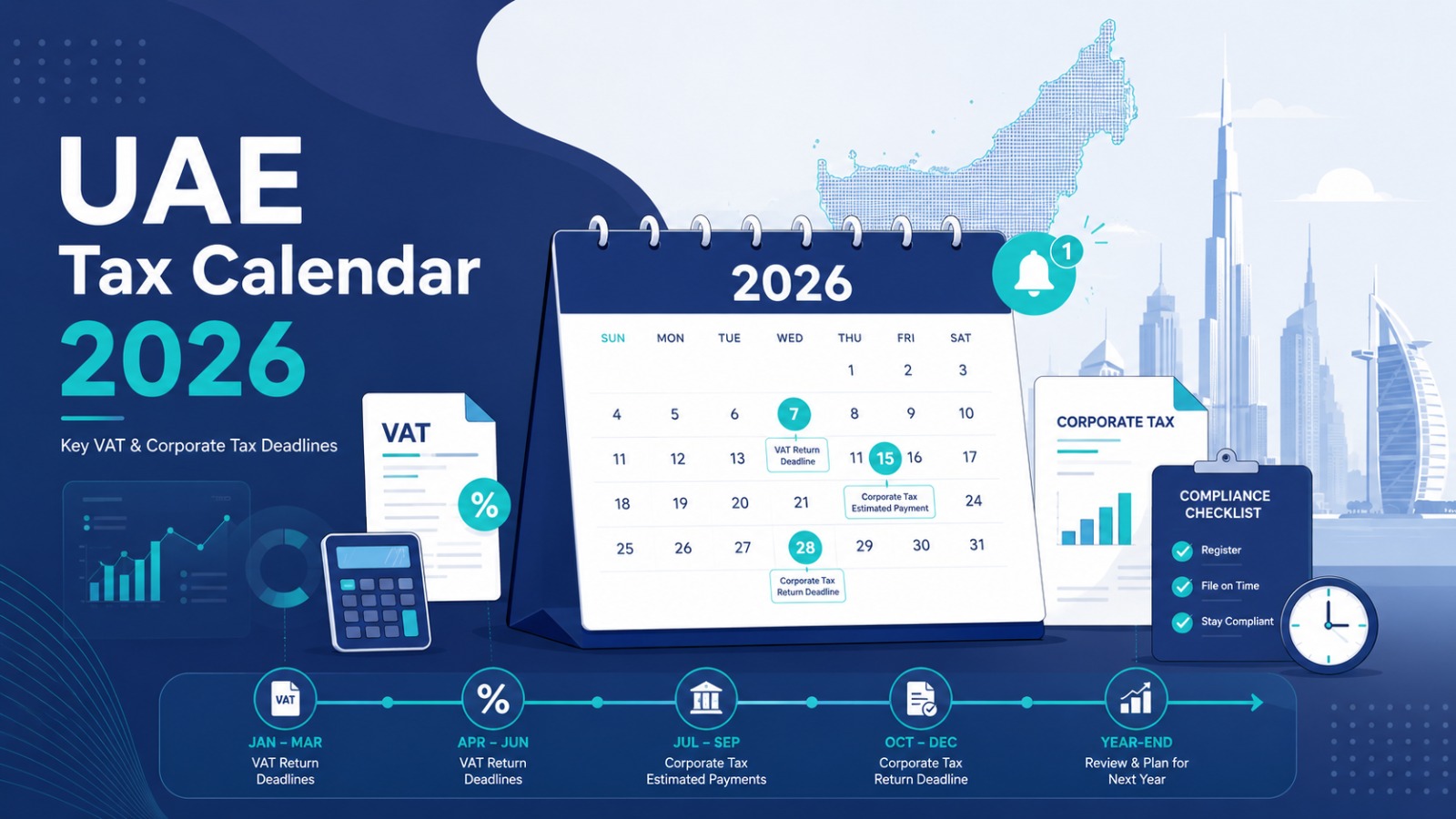
This guide puts every deadline your business needs to hit in 2026 in one place. Corporate Tax filing and payment dates by financial year end. Quarterly VAT return deadlines. The VAT refund credit deadline that is expiring this year and cannot be extended. E-invoicing milestones. WPS salary obligations. And the penalty attached to each one so you know exactly what missing it actually costs.
Corporate Tax Deadlines 2026
Corporate Tax is the most consequential addition to the UAE compliance calendar in recent years. It is also the one where the most businesses are still catching up, whether on registration, on first-time filing, or on understanding how their specific financial year end affects their deadline.
Registration Deadlines
If your business is not yet registered for Corporate Tax, the registration deadline is not something you can defer. For UAE resident entities incorporated or established on or after March 1, 2024, Corporate Tax registration is required within three months of incorporation. Missing the registration deadline carries an immediate AED 10,000 penalty.
For businesses established before March 2024 that have not yet registered, the FTA has issued registration deadlines tied to the month in which the trade license was issued. Check your registration status through EmaraTax or contact ProTax for a confirmation review.
Filing and Payment Deadlines
The Corporate Tax filing deadline is nine months from the end of the relevant tax period. For a business with a financial year ending December 31, 2025, the return filing and payment deadline is September 30, 2026. The deadline applies to both the return and the payment simultaneously. Submitting the return without paying the liability, or paying without submitting the return, is still considered non-compliance.
| Financial Year End | Filing and Payment Deadline |
|---|---|
| June 30, 2025 | March 31, 2026 |
| September 30, 2025 | June 30, 2026 |
| December 31, 2025 | September 30, 2026 |
| March 31, 2026 | December 31, 2026 |
If your financial year end does not appear above, the rule is consistent: count nine months forward from your year end date and that is your filing and payment deadline.
Free Zone Businesses
Audited Financial Statements
Audited financial statements are required for Corporate Tax filings where revenue exceeds the prescribed threshold or where the entity is a Qualifying Free Zone Person. Transfer pricing documentation must be prepared where UAE revenue exceeds AED 200 million or where the business is part of a multinational enterprise group with consolidated revenue exceeding AED 3.15 billion.
For businesses that require audited financials, the audit needs to be completed well before the Corporate Tax filing deadline. An audit still in progress when the filing deadline arrives is not an acceptable reason for a late submission. Build your audit timeline backward from your Corporate Tax deadline and make sure your auditor has everything they need at least six to eight weeks before that date.
Small Business Relief
Small Business Relief remains available for tax periods ending on or before December 31, 2026, for taxpayers with revenue below AED 3 million. The election eliminates current-year tax but prevents loss carry-forward and disqualifies the entity from certain reliefs. If your business qualifies and Small Business Relief is the right election for your situation, this decision needs to be made before the filing deadline. The election cannot be reversed once the return is submitted.
Corporate Tax Penalties in 2026
The penalty framework under Cabinet Decision No. 129 of 2025, effective April 14, 2026, restructured how Corporate Tax penalties are calculated.
| Violation | Penalty |
|---|---|
| Late registration | AED 10,000 fixed, applied immediately |
| Late filing | AED 500/month for first 12 months; AED 1,000/month from month 13 |
| Late payment | 14% per annum on outstanding tax, calculated monthly from due date |
| Failure to maintain accounting records | AED 10,000 to AED 20,000 depending on nature of failure |
VAT Deadlines 2026
VAT has been part of the UAE compliance calendar since 2018 and most businesses have their quarterly filing rhythm established. But 2026 introduces two VAT-specific deadlines that sit outside the standard quarterly cycle and are significantly more consequential than a routine return. Miss either one and the financial damage is not a monthly penalty. It is a permanent loss.
Quarterly VAT Return and Payment Deadlines
VAT returns must be filed and liabilities settled within 28 days from the end of the relevant tax period. The payment deadline is the same as the filing deadline. Submitting the return on time but paying late is still a compliance failure.
| Period | Covers | Filing and Payment Due |
|---|---|---|
| Q1 2026 | January to March 2026 | April 28, 2026 |
| Q2 2026 | April to June 2026 | July 28, 2026 |
| Q3 2026 | July to September 2026 | October 28, 2026 |
| Q4 2026 | October to December 2026 | January 28, 2027 |
VAT Penalties in 2026
| Violation | Penalty |
|---|---|
| Late filing (first offense within 24 months) | AED 1,000 |
| Late filing (subsequent offense within 24 months) | AED 2,000 |
| Late payment | 2% immediately on unpaid VAT, plus 4% monthly from day 31 |
| Incorrect return | 5% to 50% of underpaid VAT depending on nature of error |
The VAT Refund Credit Deadline: The Most Urgent Deadline of 2026
If your business generated excess input VAT in Q1 2021 and has been carrying that credit forward without claiming a refund, that credit expires in Q1 2026.
If the five-year period for a credit balance expired before January 1, 2026, or will expire within one year after that date, the taxpayer receives a transitional one-year window starting January 1, 2026 to submit a refund claim. This means businesses with old VAT credit balances from 2020 and 2021 have until December 31, 2026 to claim them. After that date, those credits are gone permanently.
The businesses most exposed to this deadline include:
- Businesses with high capital expenditure in 2020 and 2021
- Exporters who accumulated input VAT without equivalent output VAT to offset it
- Construction businesses and healthcare operators
- Manufacturers who invested heavily in equipment or fit-out during those years
The Voluntary Disclosure Window
The transition period between January and April 2026 is when businesses should review historical filings and submit voluntary disclosures under the more favorable penalty rules introduced by Cabinet Decision No. 129 of 2025. Under the new framework, voluntary disclosures attract a penalty of 1% per month on the tax difference from the original due date. If the FTA discovers the same error through an audit before you disclose it, a fixed 15% penalty applies immediately on top of the monthly charges.
If your business has any historical VAT filing errors that have not been corrected, the window to correct them under the most favorable penalty terms is now. Not next quarter.
E-Invoicing Deadlines 2026
E-invoicing is the compliance shift that is going to catch the most UAE businesses off guard over the next 12 to 24 months. Not because the deadlines are hidden. Because the implementation work required to meet them is significantly more involved than most business owners currently appreciate.
What E-Invoicing Actually Requires
The UAE’s e-invoicing mandate is not simply a requirement to send invoices by email or to use a digital invoicing tool. It is a requirement to generate, transmit, and store invoices in a structured XML format through an Accredited Service Provider connected to the FTA’s Decentralized Continuous Transaction Control and Exchange system.
This means your current invoicing process, whether that is a Word template, a PDF generated from accounting software, or a manual entry system, is not e-invoicing compliant. The transition requires:
- ERP system integration or a new invoicing platform
- An appointed Accredited Service Provider
- Staff training on new invoice workflows
- Testing within the FTA’s sandbox environment before going live
None of that happens in a few weeks.
Phase 1: Businesses With Revenue Above AED 50 Million
| Milestone | Deadline |
|---|---|
| Appoint Accredited Service Provider | July 31, 2026 |
| Full e-invoicing system operational and compliant | January 1, 2027 |
Phase 2: Businesses With Revenue Below AED 50 Million
| Milestone | Deadline |
|---|---|
| Appoint Accredited Service Provider | March 31, 2027 |
| Full implementation | July 1, 2027 |
| Government entities implementation | October 2027 |
Pilot Phase: July 2026
The FTA opens a voluntary pilot program from July 1, 2026. This pilot allows businesses to test their e-invoicing systems within the FTA’s environment before mandatory compliance kicks in for their specific phase. Participating in the pilot is not mandatory but it is strategically valuable. Businesses that participate discover integration issues, data quality problems, and workflow gaps in a low-pressure environment where the FTA is not yet enforcing penalties.
What E-Invoicing Means for Your Clients
The FTA will only recognize invoices sent via the official digital exchange as valid for VAT recovery. Non-compliant invoices cannot be used by your clients to reclaim their input VAT, creating a direct financial loss attributable to your compliance failure. In a B2B context, a supplier whose invoices cannot be used for input VAT recovery is a supplier that costs their clients money. That commercial consequence compounds quickly once e-invoicing becomes mandatory for your category.
WPS, Payroll, and Employment Compliance Deadlines
Payroll compliance in the UAE is not just an HR obligation. It is a regulatory requirement with direct consequences for business license renewals, visa processing, banking relationships, and FTA compliance standing. Missing a WPS deadline creates a cascade of operational problems that goes well beyond the immediate penalty.
Wages Protection System Deadlines
- Mainland companies must pay salaries by the 15th of each month for the previous month
- Free zone companies follow rules of their specific free zone authority, typically within 10 to 15 days after the end of the month
- Freelancers and sole proprietors are not required to register for WPS but must maintain clear payment records
The WPS deadline is not discretionary. The Ministry’s system monitors salary payments in real time. A business that consistently pays after the 15th accumulates a compliance record that affects its standing with the Ministry of Human Resources, its ability to process new work visas, and its license renewal process.
What Happens When You Miss WPS Deadlines
Free zone authorities and the Department of Economic Development factor WPS compliance into license renewal approvals. A history of late salary payments can delay or block renewal entirely.
New employee visa applications and renewals can be blocked for businesses with outstanding WPS non-compliance, creating a direct operational constraint on bringing in skilled staff.
UAE banks increasingly monitor WPS compliance as part of their overall risk assessment. Consistent WPS failures raise the same questions as VAT and Corporate Tax compliance failures.
End-of-service gratuity accrues continuously. Businesses not provisioning for this liability in their financial accounts are understating obligations and overstating profitability, which affects banking reviews and Corporate Tax filings.
DEWS and DIFC Employment Law
For businesses operating within the DIFC, the DIFC Employee Workplace Savings plan has replaced the traditional end-of-service gratuity system. Monthly contributions to DEWS are mandatory and must be paid within the prescribed timeframe. ADGM businesses operate under a similar framework. If your business is registered in either free zone, confirm that your DEWS or equivalent contributions are being processed correctly and on time as part of your 2026 compliance calendar.
Other Compliance Deadlines UAE Businesses Must Track in 2026
Corporate Tax, VAT, e-invoicing, and WPS are the primary deadline categories. But the UAE compliance calendar in 2026 includes several other obligations that run alongside these and carry their own penalties when missed.
Ultimate Beneficial Owner Disclosures
Every mainland UAE company is required to maintain a register of its Ultimate Beneficial Owners and submit that information to the relevant authority. UBO disclosure obligations apply regardless of company size and the registry must be kept current.
If your business has undergone any ownership changes, restructuring, or shareholding adjustments in the past 12 months, the UBO register must reflect those changes. Maintaining an outdated UBO register is a compliance failure that UAE banks now check as part of their standard account management process.
AML Reporting for DNFBPs
Businesses classified as Designated Non-Financial Businesses and Professions under UAE AML law have specific reporting and compliance obligations. DNFBPs include:
- Real estate agents and brokers
- Dealers in precious metals and stones
- Auditors and accountants
- Corporate service providers
- Lawyers
If your business falls into any of these categories, your AML compliance obligations include maintaining a current risk assessment, conducting customer due diligence on all relevant clients, filing Suspicious Transaction Reports where required, and submitting annual compliance reports through the GoAML platform. Missing AML reporting deadlines carries penalties that escalate quickly and can affect your ability to operate in regulated sectors.
Free Zone Audit Submission Deadlines
Most UAE free zones require member businesses to submit audited financial statements to the free zone authority on an annual basis. The deadline is typically tied to the financial year end and varies by free zone. Late audit submissions can trigger fines, temporary suspension of services, or rejection of license renewal.
Trade License Renewals
Missing the renewal deadline does not just trigger a fine. It creates a gap in your licensed status that affects your ability to issue compliant tax invoices, process visa applications, and maintain your bank account. An expired trade license creates knock-on problems across VAT compliance, Corporate Tax registration, banking relationships, and visa processing that take significantly longer to resolve than simply renewing the license on time.
Build your license renewal date into your compliance calendar at least 60 days ahead of expiry to prepare required documentation, address any outstanding compliance issues, and process the renewal without a gap in your licensed status.
ESR Notification and Reporting
Economic Substance Regulations apply to UAE businesses conducting relevant activities including banking, insurance, fund management, leasing, headquarters activities, shipping, holding company activities, intellectual property activities, and distribution and service center activities.
- ESR notification: within six months of financial year end
- ESR report: within 12 months of financial year end
| ESR Violation | Penalty Range |
|---|---|
| Failing to file notification (first offense) | AED 20,000 |
| Failing to file notification (subsequent offense) | AED 400,000 |
| Failing to file report or failing substance test | AED 50,000 to AED 400,000 |
The Real Cost of Missing Deadlines in 2026
Every section in this guide has included the penalty attached to each deadline. But penalties in isolation do not tell the full story. The fine is the visible part. What follows the fine is usually more damaging and significantly harder to reverse.
The Compounding Effect of Multiple Missed Deadlines
Businesses that miss one deadline tend to miss others for the same underlying reason: no structured compliance calendar, no advance preparation, and no dedicated resource managing the obligation before it becomes urgent. Each individual penalty is manageable in isolation. Combined, across a single compliance period, the total penalty exposure can reach into the hundreds of thousands of dirhams before any human at the FTA has manually reviewed a single document.
The FTA Risk Profile That Follows Every Missed Deadline
Every missed deadline, every late filing, and every penalty payment goes into the FTA’s risk scoring system. That score does not reset when the penalty is paid. It accumulates over time and determines how frequently your business is selected for inspection visits, how much scrutiny is applied to each filing you submit, and how quickly an FTA query escalates to a formal audit.
A business with a clean compliance record and a business with three late filings over 18 months submit identical VAT returns. The FTA’s system treats them differently. The clean business gets processed. The business with the compliance history gets a closer look. Enforcement programs are driven by risk indicators, not random selection.
The Banking Consequence
UAE banks conduct their own compliance reviews as part of ongoing relationship management. The banking consequences of missed compliance deadlines rarely arrive as an explicit conversation. They surface in facility renewals that take longer than expected, credit limit reviews that result in lower than anticipated approvals, and trade finance applications that generate more questions than they used to.
For businesses that depend on credit facilities, trade finance, or import letters of credit to operate at the scale their business requires, the banking consequence of a compliance track record problem is a direct constraint on operational capacity.
The Opportunity Cost Nobody Calculates
Beyond penalties and banking complications sits the cost that never appears on a fine notice: management time. A business owner who spends three weeks managing an FTA audit response, two weeks reconstructing records for a Corporate Tax filing that should have been prepared months earlier, and one week resolving a trade license renewal that was left too late is spending six weeks of management attention on compliance problems instead of revenue-generating activity.
The businesses that have been through an extended FTA audit consistently say the same thing afterward: the cost of getting it right from the start is a fraction of the cost of fixing it under pressure.
A Scenario: What Multiple Missed Deadlines Look Like in Real Numbers
A Dubai mainland trading company with a December 31, 2025 financial year end misses the following in 2026:
- Corporate Tax filing deadline of September 30, 2026 by 45 days: AED 500 per month penalty begins, with the first month’s penalty applied immediately.
- Q2 VAT return filed 12 days late: AED 1,000 first offense penalty plus 2% on unpaid VAT immediately, plus 4% monthly from day 31.
Both penalties run simultaneously. Neither waits for the other to be resolved before accruing. This is the compounding reality of operating without a managed compliance calendar in 2026.
Conclusion
Go back to the business owner from the opening of this guide. Eleven days late on a Corporate Tax filing. Four other deadlines running simultaneously that month. A penalty that compounded. An audit flag that followed. Banking questions he had never been asked before. Weeks of management time consumed by a problem that should never have existed.
He was not careless. He was not trying to avoid his obligations. He was simply managing more compliance deadlines than his internal systems could track without something slipping through.
That is the reality of running a business in the UAE in 2026. Corporate Tax has added a major annual filing cycle on top of an already active VAT calendar. The new penalty framework means missed deadlines are more expensive than they were 12 months ago. E-invoicing is adding a technology implementation requirement on top of the existing compliance obligations. WPS, UBO, ESR, free zone audits, and license renewals run alongside all of it without pausing.
The businesses that thrive in this environment made a decision early to treat compliance as a managed business function rather than a reactive back-office task. They engaged the right advisory partner. They built their calendar. They stopped being surprised by deadlines.
The cost of managing your 2026 compliance calendar correctly is a professional advisory fee and the discipline to follow a structured process. The cost of getting it wrong is everything covered in the section above, compounding, quietly, until it is no longer quiet.
Book Your Free Compliance Consultation Today
Bring your deadlines. Bring your questions. Leave with a compliance plan that makes 2026 the year your business stopped worrying about what it might have missed. The ProTax team is ready at protax.biz.